

First Sentence Fridays celebrates the prose and process of new books.
Peter Jaros’s The Corporate Forms of Antebellum US Literature (Oxford UP) tells the story of the corporation in antebellum US law, literature, and culture. It unfolds a rich and varied corporate imaginary that both illuminates the prehistory of today’s corporations and captures forgotten and unrealized conceptions of personhood, politics, and collectivity. Centered on an era during which both person and corporation were contested terms, this book shows how a seemingly instrumental legal category spurred reflection on human identity, mortality and immortality, slavery and freedom, and the possibilities of social and political belonging.
AVIDLY: What’s the first sentence of your book? No cheating!
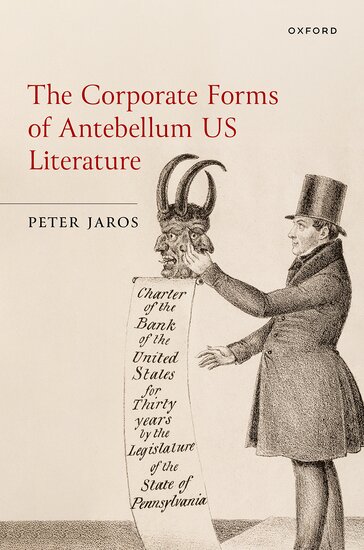
Peter Jaros: From the Supreme Court’s expansions of corporate power in Citizens United v. FEC (2010) and Burwell v. Hobby Lobby (2014) to Mitt Romney’s 2011 assertion that “Corporations are people, my friend” and the angry rejoinder “No, they’re not!,” debates about corporations—particularly over the doctrine of corporate personality— have marked American political discourse in the early twenty-first century.
What’s something you remember about writing this sentence? Where were you? When in the book writing did you write it?
I don’t recall just where and when I wrote this sentence, but I can tell you it was late in the game. I’m pretty sure I drafted it when I was writing a summary of the project. I know I was trying to establish common ground with readers’ background knowledge and gut feelings about the word “corporation.” This book grapples with a lot of knotty concepts, so I wanted to get readers into a familiar space before the floor dropped out and we landed in the fascinating, messy details.
I should also mention that I precede this sentence with two epigraphs from hypercanonical literary texts: Emerson’s “Self-Reliance” and Melville’s Moby-Dick. So I guess I’m nudging the reader to wonder how those two well-known (if you’re a certain kind of reader) American lit moments connect to this sentence about our recent past.
Now that it’s all written and done, what occurs to you about how your first sentence connects to the book as a whole? In the ideas, style, experience?
It’s a pretty neutral-sounding sentence, so it sets up a kind of bait-and-switch. I think the book as a whole gets a lot weirder, nerdier, and more fun as it goes on. Nineteenth-century writers shared some of our intuitions about corporations but went places with them that can test our imaginations.
In the intro I try to come through on that promise by doing things like taking seriously Ishmael’s description of the “joint stock company of two” he forms with Queequeg when the two are tied together by a “monkey-rope.” Melville realizes that the corporation can help us imagine very different forms of human plurality. For Melville, a corporation might be more than a faceless company — it could be a spontaneous collective.
In each chapter, I try to make a bargain with the reader: Start with an image or problem, stick around while I get some legal, theoretical, and historical circuitry on the table, and then watch as a seemingly dusty text lights up in surprising ways.
Tell us one or two specific details about how you like to write: home/office/café, soundtrack or silence, favorite mug, favorite hoodie, preferred mode of pencil/pen/notebook/font/software?
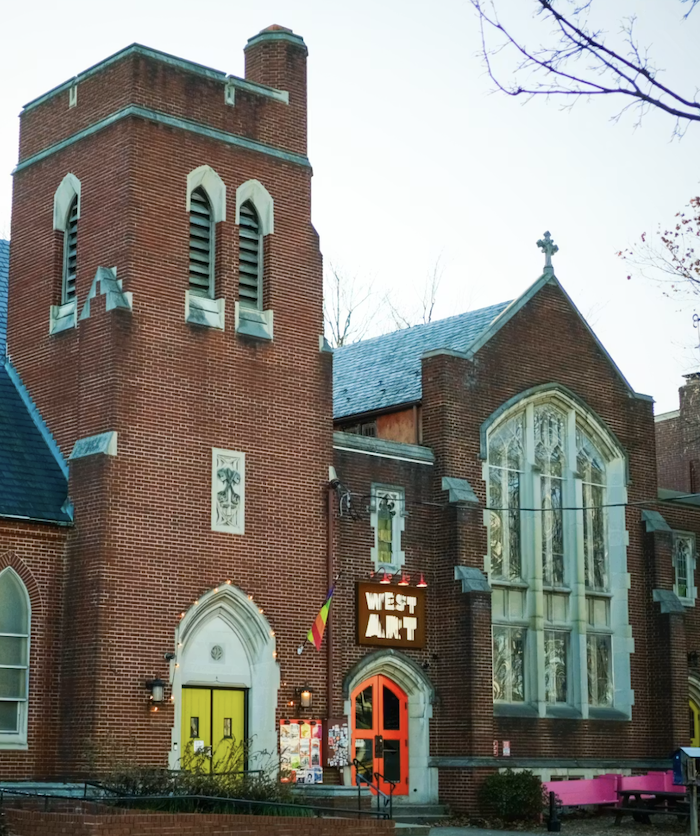
When everyone else in my house is at school or work, I like the dining room table (great light, not too many distractions). But I also love the café around the corner that used to be a church, where I put music in my ears and enjoy the feeling of pushing back against a bit of novelty and distraction.
I work best when I can frame the writing process as defining and then negotiating particular problems: lay out these two concepts and the tension between them; dig into what’s really creepy or fun about this seemingly innocuous paragraph; quickly catalogue a bunch of moments that are saying versions of the same thing.
In between these bursts, I do a lot of getting up and walking around—a habit that will surprise no one who knows me.
Need more music info! What’s one specific album or song or…sound… you associate with writing this book— or even writing the first sentence? (As I think you know, I basically only write to the Kate Bush.) Are you monomaniacal or do you mix it up?
Gotta mix it up! A lot of this book was written to a soundtrack of live performances on KEXP’s youtube channel. If I was on a roll I would skip the interview portion, but if I felt like I’d hit a good stopping point, I’d reward myself with Cheryl Waters’s conversation with the band. In short, an indulgent version of the pomodoro method.
Tell us one other thing you worked hard on in this book and are proud of!
What I worked hardest on, I think, was really trying to make dense material speak to readers with different kinds of disciplinary knowledge. I’m writing for other nineteenth-century Americanists of course, but I’m also hoping to talk to people coming from legal studies and beyond.
Because the book is in Oxford’s Law & Literature series, one of my readers was a legal historian—someone grounded in a discipline on which I rely but in which I’m not trained as a scholar. That reader gave me some tough feedback, but in doing so, I think, gave me the opportunity to make the book stronger and less provincial. I hope the upside of this interdisciplinary boot camp is that curious lay readers, as well as academics from different fields, will find the book congenial.
What’s your favorite sentence in the book? What do you like about it?
One that I like a lot is the first sentence of chapter 3: “The dénouement of Robert Montgomery Bird’s Sheppard Lee, Written by Himself (1836) is as disappointing as the novel’s premise is titillating.”
It’s much more efficient and decisive than I am in real life. If you’ve read the novel, you’ll either agree with me or want to fight. And if you haven’t, I hope I’ve provoked you to come along for the ride.
Share the love: what’s a first sentence written by someone else (any genre!) that you think is great?
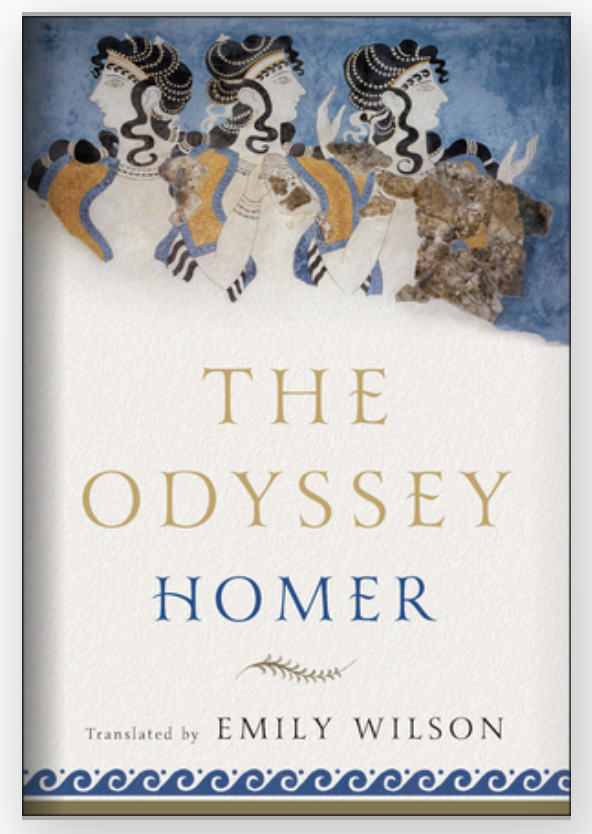
I’m in summer road trip mode, of which two crucial constituents are audiobooks and karaoke. So I’ll give you an absolute banger from each genre. From Emily Wilson’s translation of the Odyssey: “Tell me about a complicated man.” From the late David Berman’s stunning song “Random Rules”: “In 1984 I was hospitalized for approaching perfection.”
Peter Jaros is Professor of English at Franklin & Marshall College, where he teaches American literature and recently co-led a community-engaged humanities project, Reckoning with Lancaster: The Question of Abolition. His work has appeared in places like American Literary History, J19: The Journal of Nineteenth-Century Americanists, the collection Human Rights after Corporate Personhood: An Uneasy Merger, and the Elgar Concise Encyclopedia of Law and Literature.all College.
Order The Corporate Forms of Antebellum US Literature. You can use the code AUFLY30 to save 30% when ordering direct from the press. Drop date is July 28!

Discover more from Avidly
Subscribe to get the latest posts sent to your email.