

Dolly Parton was an American hair icon. She was also a moral beacon and one of three best white pop songwriters of the last sixty years (the other two are Carole King and Taylor Swift; this is science). [1] These things are connected. Dolly Parton’s vast parade of blond wigs played a significant part in both her moral and aesthetic genius.
Importantly, Dolly Parton’s hair was always “her” hair, even as it was never the same hair, and even though the hair never grew from her (or anyone’s) head. Her long-time wig stylist was her aunt, Colleen Owens, who she praised consistently as a creative genius in her own right. And it’s undeniably true.
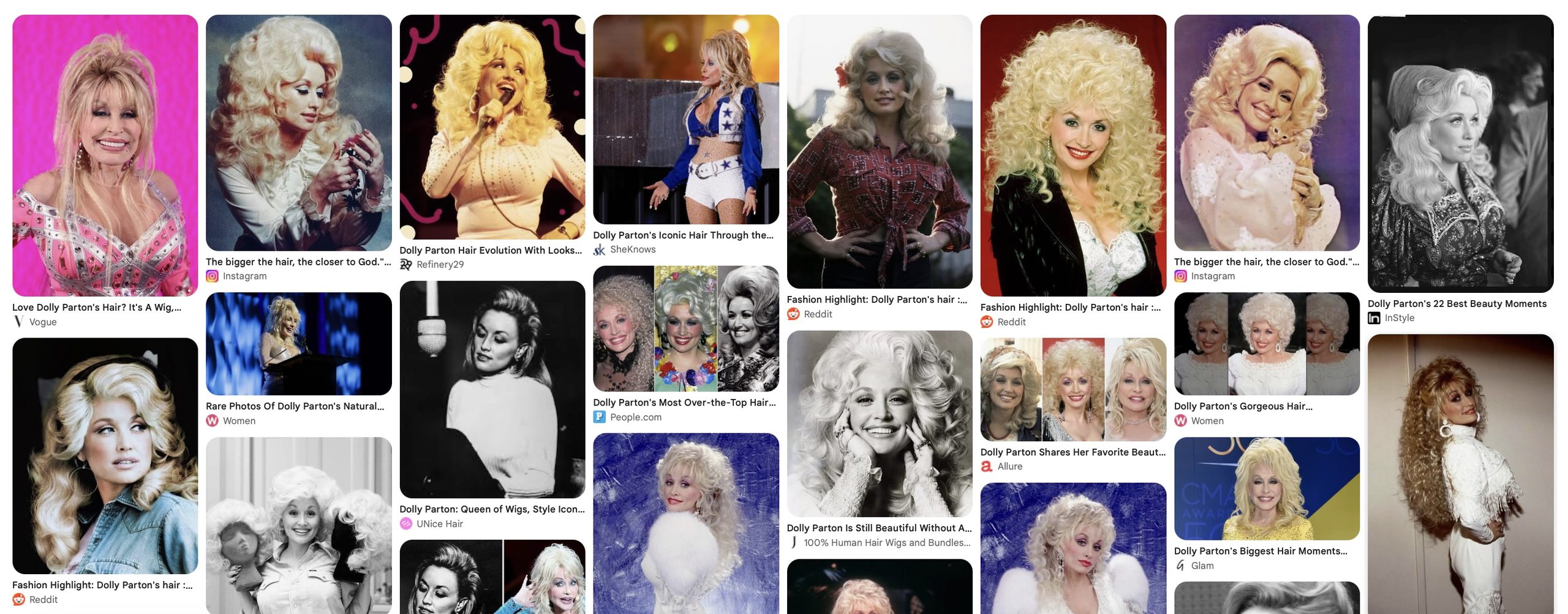
If you google “Dolly Parton hair” you will see a gorgeous medley of blond events. Sometimes her hair flows soft and wave-like over her shoulders. Sometimes it’s crimped or flat-ironed streaky-straight. In many of its most famous versions, it’s teased and curled into a hovering blond nimbus. The images, taken together, show us what we’ve been treated to in the many years of Parton’s stardom. Dolly Parton’s hair is like a much-beloved soap opera, in that it has offered constant character drama synthesized with a succoring endurance. It doesn’t matter where we were in life, or in style. We could always count on Parton’s wigs meeting the moment.
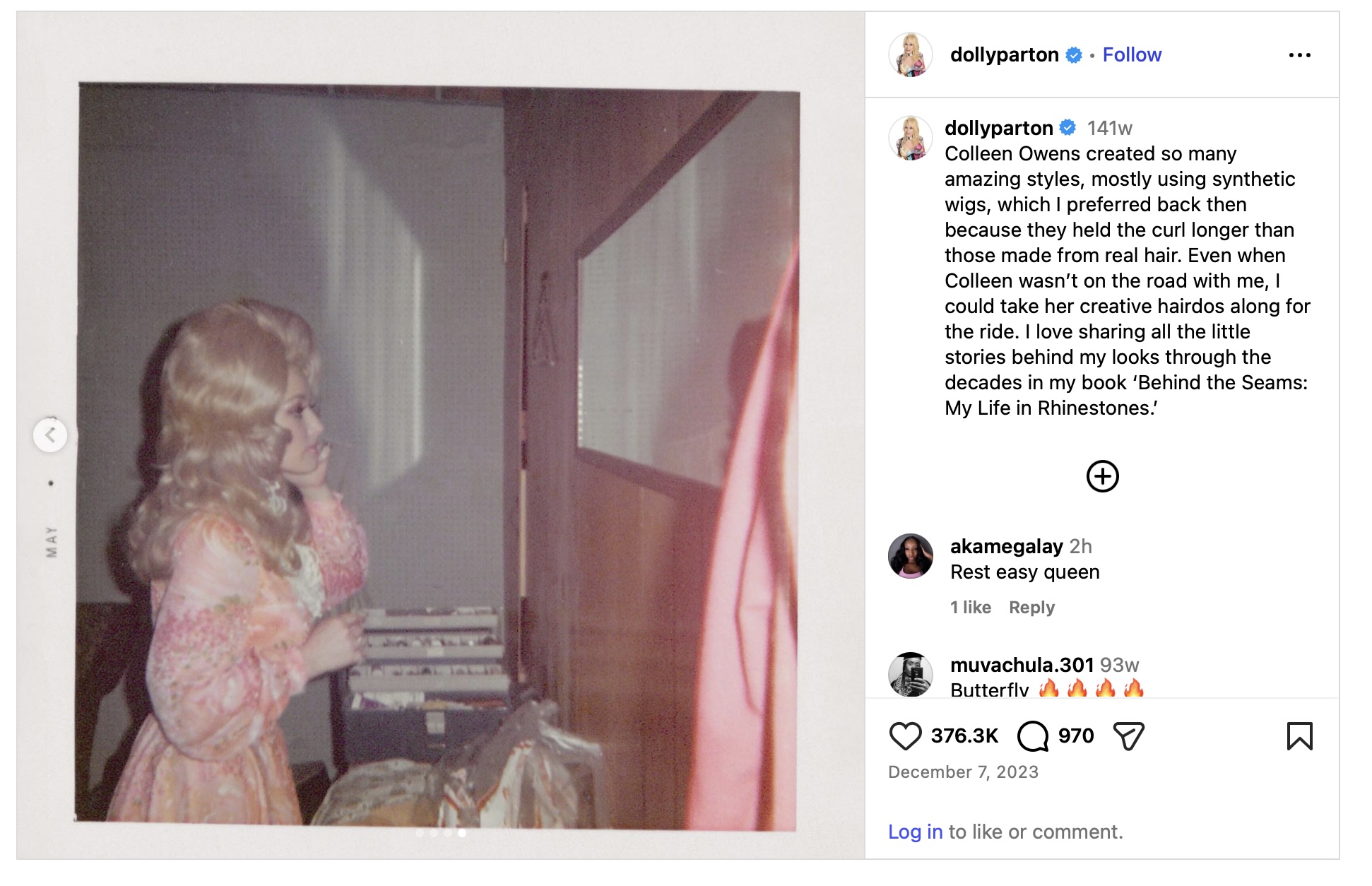
In a 2023 Instagram post, Parton explained that she preferred synthetic wigs, which were better at holding a curl. It’s entirely consistent with Parton’s ethos that she valued endurance and performance over other qualities “natural” hair might signal, such as expense or even taste. Dolly Parton’s hair became hers because she knew authenticity didn’t mean complying with a market’s version of the “real.”
The specific market I mean is the ongoing exchange in white feminine ideals carried out by American white culture. American whiteness goes through different cycles, but since the nineteenth-century it’s focused on the same virtues. Moral innocence, maternal love; white women win praise when they uphold these qualities as authentic to whiteness itself. White America —with all the institutions it has at its disposal, ranging from the stock market to ‘Bama rush— loves young white women who value the beauty that will please white men. It appreciates older white women who martyr themselves in the care of (their own) white children. In both life phases, white America wants signs of loyalty, of fidelity. It wants to be confident that a woman’s behavior and appearance connect to her inner truth. So it lifts up signs of the “natural,” as a primary aesthetic value. As a secondary quality, it will accept the “expensive,” because white men have a corner on economic status, and loving to look rich typically signals you’d be willing to love the white men who could make you so. Hair isn’t the only way white women have indicated their investment in naturalness, or expense, but it is one very important way, as I have said a few times.
Dolly Parton is certainly not free of whiteness. She is made of it and moves within it. But she does she while brilliantly short-circuiting her way around its ideological machinery. Her hyper-blond wigs show that she sees the power of white norms and that she rejects fidelity to their terms.
Dolly Parton’s hair was real—touchable, textural, ever-present—but not natural. It was abundant, luxurious, and surely expensive, yet placed no social premium of looking rich. Parton retained her hair as a sign of a morally accountable self, but also used it signal how little she cared for the normalized, dangerously narrow feminine scripts of prosperity and sentimentalism.
Even I won’t pretend that having enduringly magical hair matters as much as other things Dolly did. Dolly Parton donated 200 million books to young children; she transmitted the riff from Jolene straight from the heavens to this fallen earthly plain. Next to these accomplishments, “hair icon” may seem like a small portion of her legacy. But Dolly Parton’s hair matters to every moment of how her legacy was experienced.
Dolly Parton cared about love. Like all pop songwriters, she made it the subject of her art. But even as her songs worked continual surprise from the pop scripts of heteronormative enchantment and betrayal, Dolly’s hair showed us that she did not accept the conventional limits of what “authentic” love should be. It was a chosen authenticity, and it was the sign of how she loved her chosen family. Just as her hair was hers, her songs were hers. The children she gave books to were hers. The queer, trans, and variously unruly fans who loved her— it seems to me— saw in her hair the proof of their (our) own reality, our own self-possession.
Dolly will always love us, her songs and her actions said. Her hair, chosen and gorgeous, was the visual emblem that her loved “us” truly meant everyone.
Sarah Mesle: A little judgy
[1] It may seem to narrow the range of these artists by calling them “pop,” given how brilliantly all three work across country, folk, soul and rock. But I mean pop as the highest praise, as a term that signals their ability to make the creatively outrageous feel easy to absorb. Pop depends on creating sincerity and surprise out of prefabricated formulas. Women, in our world, remain stuck with an astonishingly narrow range of formulas. We might sum up these equations in Lauren Berlant’s terms: women are only handed formulas for a life lived for love, “and love is the gift that keeps on taking.” I am not the critic who can parse the degree to which Berlant’s maxim applies to non-white women, but I know it does apply to white women who want to live within received genres of white femininity. And I also know that this narrowness explains why all the best pop songwriters are always women: the limit on the material pressurizes their craft into, if not diamonds, something better: rhinestones.
Discover more from Avidly
Subscribe to get the latest posts sent to your email.