

How does hair matter to feminism? Specifically, how does long, straight, brown, hair matter to feminism? I’m talking about Gloria Steinem’s hair. Steinem is not the only feminist; her hair is hardly the only feminist hair. Still, you can picture it: fifty years of the same flowing style. Middle-part, middle-brown, usually the same middle-length. Never short. Enduring. However you feel about Gloria Steinem, whether you consider her a necessary radical or a stealth revanchist, her hair remains the visual metaphor for her politics. I love Gloria Steinem. I love Gloria Steinem’s hair.
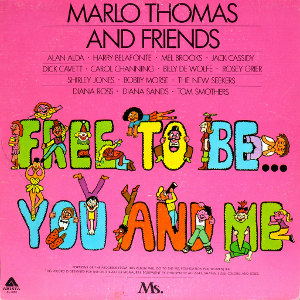
Why do I love it? I grew up in the 80s. The 80s were a hard time for feminism, but my family was purposefully, proudly, joyfully feminist. Steinem was literally a household name. My parents had carefully articulated strategies for dividing house and child care. My brother and I always knew we were free to be our own man, our own woman. This philosophy of life – among the best gifts my parents gave me, one I still unwrap every day—took hair as its image. My bearded dad mopping the kitchen floor on Saturdays, listening to Carly Simon and Carole King (both with brown, middle-parted hair). My mom (brown, middle-parted hair), studying for her PhD exams while my dad cleaned.
Marlo’s album, Carly’s album, Carole’s album, all came out in the early 70s. In the early 70s, Gloria Steinem first grew what we would now call Gloria Steinem’s hair, a transformation much noted at the time, both admiringly and dismissively.[i] She wore it at the 1972 Democratic Convention, she wore it when she co-founded Ms. magazine, she wore it while on a speaking tour with Dorothy Pitman Hughes.
Steinem was not the only white woman at the convention, at the protests, with this brown-middle parted hair, nor was she the first to have it. But here’s the thing: Steinem kept her hair.
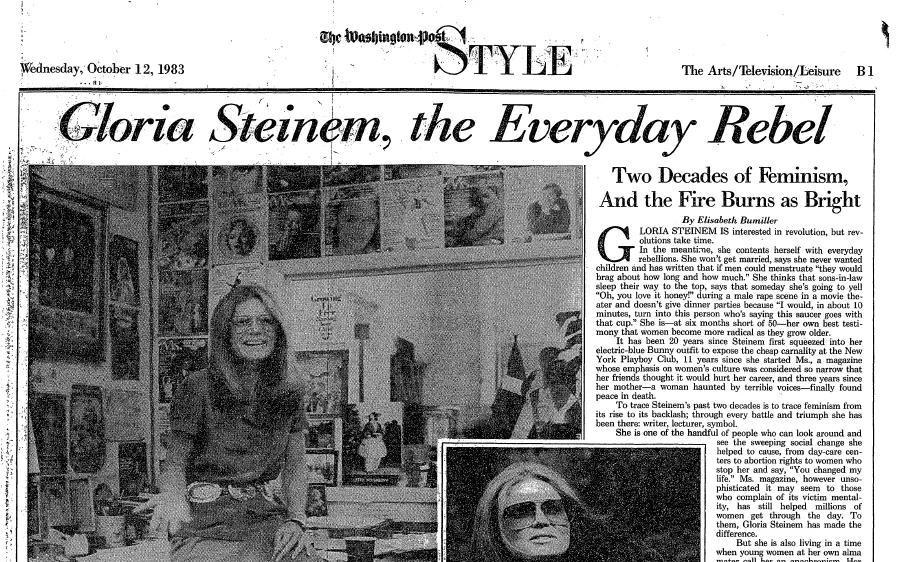
In 1983, when I was seven, the Washington Post ran a profile of Steinem. We were three years into Reagan; feminism was in retreat. The Post knew it. “Her old friends and imitators have cut their hair,” it tells us, “but Steinem’s is still long and straight, parted right down the middle.” The world was changing. Steinem’s hair showed she hadn’t given up on the cause.
*
Gloria Steinem’s hair poses some provocations for #hairstudies because it became iconic while not being especially remarkable. Has it always looked healthy, pretty, enviably lovely? Yes. But even among the mid-seventies white and feminist icons of my childhood Steinem’s hair is not the “best.” By “best” I obviously don’t mean what you or I like most; I mean “the preferences that reproduce the existing social order,” which is to say, “best” at achieving a structural standard by which all white women, at least, are trained to judge each other.[ii] If we’re just talking about beautiful hair, Carly’s was glossier. Marlo’s was more stylish.
Steinem’s hair, on the other hand, achieves that most unusual thing: a white American ideal that still looks, basically, normal. Not normal as in average, or what most white women actually have, but rather normal in the more judgy American sense of the term: what most white women should have.[iii] This normativity was part of its power, and I am entirely sure that Steinem knew it.
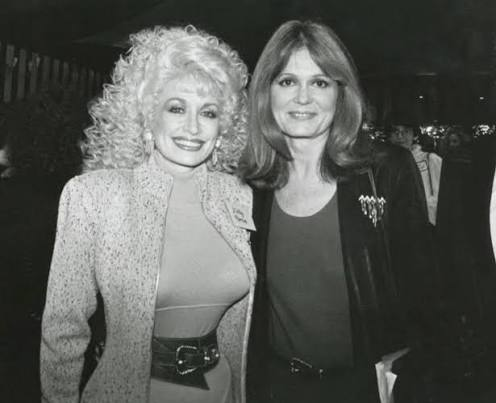
In this, as in many ways, our analysis benefits by comparing Steinem to Dolly Parton, her friend. Parton wore her performance of ideal white femininity overtly, acknowledging the costume white femininity always is. Steinem’s costume remains harder to see as such. Parton’s hair was made possible by newly-developed synthetic fibers; Steinem’s was made possible by newly-developed conditioners and dyes.[iv] But industrial chemical manufacturing isn’t what I see when I look at Steinem’s hair, even though I know it’s there. My eyes have been trained to overlook it. Steinem’s hair grew from her head in such a way that she had access to that highly-desirable costume, the one Carole King described as “a natural woman.”
Nature, in the wild, changes.[v] It’s only “natural,” the cultural construct, that appears enduring, everlasting. The famous portraits of Steinem and Pitman Hughes show two women with hair we might describe as “natural.” The difference between them—the difference in perceived emotion and public vulnerability on hair display—shows how laden with power and history ideas about “natural” are. Next to Pitman Hughes, what does Steinem’s hair do? It is a shelter, a pledge of allegiance. It is also a deployment of the “natural” that rests on hierarchy.
Dolly Parton is universally beloved. The loss of her public figure is terrible, but her death is straightforward to elegize, even for those with no particular attachment to her artistry. Remembrances of Gloria Steinem, like this one, are spikier. Many, like this one, include a projection of an imagined other attacking Steinem that is partially about the author’s own mixed response. Even as I knew instantly that I wanted to memorialize Steinem, I felt my hackles raise. I want to protect her from the accusations I knew would come. They would come because of everyone’s ambivalent feelings—admiration, envy, necessary critique—about the naturalized costume Steinem wore so well, so strategically, for so long.
*
How does hair matter to feminism? In 1989, Alice Echols wrote Daring to Be Bad, her famed history of the feminist movement. In its introduction, Echols waffles over what led America away from feminism, towards the elitist horror of the Reagan era. Feminism was over-criticized, Echols brilliantly shows. Its fissures were overblown and exploited by a hyper-masculine mass media that found feminism threatening. Still, Echols has her own concerns about feminism’s focus. Had feminism gotten bogged down in the overly-personal, the trivial? Guess what she takes as an example of the trivial. “Everything from hairstyles to sexual preference,” she says, became “something to be embraced or critiqued on political grounds.”[vi]
Gloria Steinem organized, ceaselessly, for abortion rights, for access to childcare, welfare, media realignment. For anger. She worked coalitionally across identies. She built. Conservative (and often white) American institutions found all these positions abhorrent. It wanted to call them unnatural. Steinem’s image worked, sometimes better and sometimes worse, as prophylactic against these accusations. How could abortion rights, or the ERA, be unnatural or freakish, when Steinem’s hair looked so healthy, so normal, so natural? Her hair was a power, a resource. Steinem used it for her cause.
It is no surprise to me, then, that a hyper-masculine mediasphere tried to undermine both feminist politics and the hair symbolism that Steinem’s feminism took as its tool. Consider, for instance, Time magazine’s 1972 reporting on the growing tensions between Steinem and Betty Friedan. Time wanted its readers to know that their fights were funny, a sign of feminist unseriousness. (These arguments were not unserious; they were deadly serious. They were about about Ms. magazine, about money, about who to support for political office. They were about, also, sexual preference.) Time magazine thought the arguments were so cute. They called Friedan and Steinem’s fight “a bit of sisterly hair-pulling.”
Here is the remarkable accomplishment of Gloria Steinem’s hair: for over fifty years it weaponized a white middle-American normal ideal in the service of intersectional, sometimes radical, feminist politics. Everything about our world’s status quo needs to be rethought, she said. Everything, her image conceded, except America’s ideal of hair. It was a ruse she deployed to gain the territory she wanted to win.
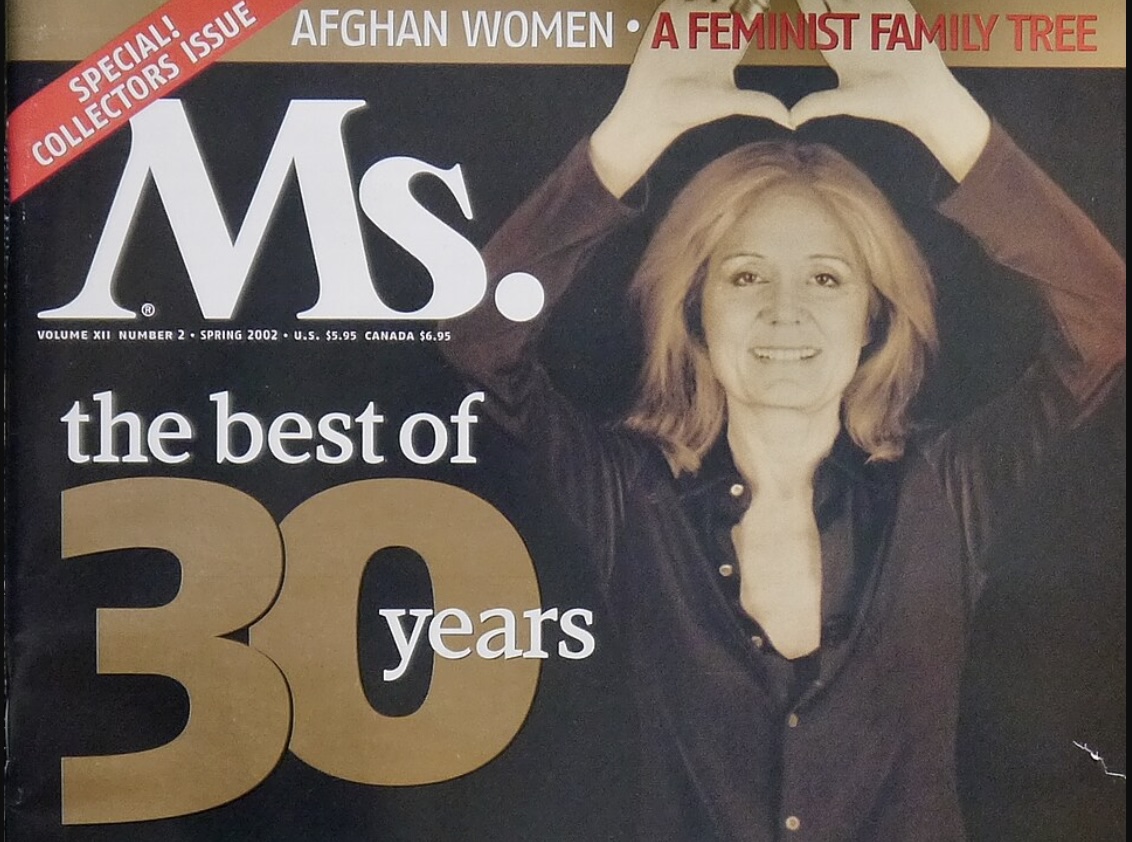
Was it wrong for Steinem to use her hair to make feminism look “natural,” look pretty, in a world where both nature and beauty culture are ideals generated by and through white supremacy? Some will say so, and I take that position seriously. Steinem’s politics are not those normally referred to as “white feminism,” but her physical whiteness was always on purposeful display. Steinem worked for the CIA and she worked to keep her hair compliant with white feminine standards. If these are not equivalent as political gestures, both are compromises with fundamental institutions of white America’s power. If you look at Steinem and see revanchist complicity or a failure of intersectional feminism, her normative appeal is what you are witnessing, and you are not wrong.
But for my part, I think the fight facing us is too dire to abandon any weapon we might use. At this moment, I see only imperfect tools. I am not willing to cede any of them. I will not let MAGA claim long straight hair’s cultural power for itself. It’s not just straight brown white woman’s hair, it’s universities, election cycles, America itself. All these are rooted in the worst kind of resource hoarding. I see people I admire opting out, and I get why. But it is not what Gloria Steinem did. She stayed in it all, until the end. I love her for it.
In 1983, when the Post was reporting on Steinem’s long-hair, my mom and I were among the many American women who had opted for short hair. This was feminist too. Time is a resource, and long straight hair takes a lot of it—washing and brushing, conditioning. Both cutting and growing your hair are choices about resources, time among them. Feminism means distributing access to resources and the choices that resources give. How does hair matter to feminism? So many ways. I wanted, still want, to keep mine long.
Sarah Mesle: A Little Judgy
All images of Steinem from WikiCommons
[i] In 1972 Nora Ephron described Steinem’s dedication to feminism as undergoing a “metamorphosis” that was “a little frightening and almost awe-inspiring.” You should definitely read this essay. It is partially a response to a 1971 “profile” of Steinem, Leonard Levit’s “She,” which astonishes in its cruelty throughout. (It is a “good” hate read if you really want an encounter with what Steinem was up against.) Levit describes Steinem’s movement towards feminism this way: “This mild-mannered reporter has, all her life, slipped into phone booths and emerged a new person with a new costume and a new set of beliefs. She was once plump and brunette. Now she is thin, with blonde streaks in her hair.” Levit is not wrong to link weight and hair as visual signifiers, but his use of both to discredit Steinem’s political integrity instead dismantles his own.
[ii] McMillan Cottom, Tressie. “In the Name of Beauty.” Thick: And Other Essays, The New Press, 2019, pp. 37–56, 44.
[iii] See for instance Davis, Lennard J. Enforcing Normalcy: Disability, Deafness, and the Body. Verso, 1995.
[iv] Here I cannot make any claim to knowing about Steinem’s specific program of conditioners and dyes. I also did not live through the hair product transformation of the 50s-70s. But I have spent a lot of time looking at advertisements for conditioners published during the 60s and 70s, when in-home hair conditioners like the ones I use every day became readily available. I would like to understand more about this specific moment in hair technology; it does seem to me the case that the reason you didn’t see much “natural” hair like Steinem’s in the 40s and 50s is that the chemicals required to make it look simultaneously just brushed and not oily did not yet exist. In 2021 Steinem described her own beauty system as “mostly moisturizers.” I believe her basically but this is definitely a partial account.
[v] Both hair and fat— and these often go together, in discussions of Steinem’s appearance—are “constantly motile” parts of the body. To keep both consistent, as Steinem has, requires effort. Here I quote: 2017. Darwin, Helana. The Pariah Femininity Hierarchy: comparing white women’s body hair and fat stigmas in the United States, Gender, Place, & Culture: a journal of feminist geography
[vi] Echols, Alice, Daring to Be Bad, University of Minnesota press, xix.
Discover more from Avidly
Subscribe to get the latest posts sent to your email.