

For lovers of Emily Bronte’s classic 1847 gothic novel, Emerald Fennell’s new film adaptation of “Wuthering Heights” is full of surprises, from the gratuitous public hanging at the movie’s start, to the servants sneaking off to have kinky bridle sex in the stables. (Neither of these scenes appears in the book, nor has anything to do with the central plot.) But perhapsthe most surprising feature of the film is that it renders the torrid sex between very hot Catherine (Margot Robbie) and very hot Healthcliff (Jason Elordi) into chemistry that’s bafflingly…tame? It’s not that Fennell can’t do sexy: the supporting characters are positively dripping with erotic, borderline-pornographic enthusiasm. But when Catherine and Heathcliff finally come together, they mostly just trade kisses and whisper “I love you” back and forth. It’s sweet, but compared to the film’s baseline, shockingly bland.
So where does all that tortured, brooding, straight-up weird energy go? Clearly, it’s all in her hair. As we watch young Cathy grow up, we see her loose waves become increasingly bound—and unbound—in sync with her sexual expression. When she’s satisfied, her hair blows in the wind, drips in the rain. When she’s frustrated, her hair is woven and pinned into increasingly stiff styles. Catherine’s tresses, in other words, are where she stores all her sexual tension. (It’s a little like how, in Mean Girls, Gretchen Weiner’s hair is where she stores all her secrets). This is a shame for viewers who would like to see a bit more of that sexiness actually play out on screen. But it does make for some deeply delicious updos.
The theory’s a little twisted, I know, but hear (hair?) me out.
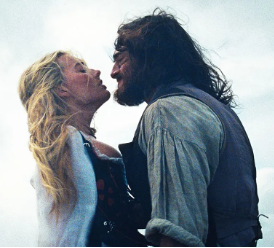
Image: Warner Bros via the BBC
As a child, Catherine’s hair flows in unrestrained, naturalistic waves, whipped by the wind on the moors. As she ages, becoming less impulsive and more strategic, we notice a corresponding metamorphosis in her hairstyle. Her hair will remain relatively unbound when she is pursuing her own desires—masturbating on the moors, for instance, or making out with Heathcliff. In these scenes, her hair may not be completely free, but it is usually only partially braided or casually twisted into a loose half-pony. However, when Catherine turns her attention towards engineering her marriage to wealthy neighbor Edgar Linton, we can tell right away that the attraction is pragmatic, rather than erotic, from the tied and twisted hairstyles she wears at his estate.
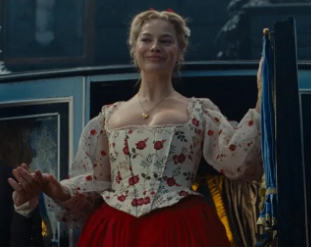
Image: Warner Bros via the ipaper
The parade of intricate updos kicks off upon Catherine’s homecoming from the Lintons’ estate, where she has been convalescing after spraining her ankle just outside their garden. On her return, her companion Nelly (Hong Chao) exclaims, “Why Catherine, you are transformed!” And certainly, she is, from her bold new outfit to her haughty new air. But Catherine credits the metamorphosis entirely to her new hairstyle, styled by Edgar’s young ward Isabella. Hairdressing is, in fact, Isabella’s “special talent,” as Catherine enthuses to Nelly, and she even has a whole room “just for her ribbons.” When Catherine eventually marries Edgar and moves to Thrushcross Grange, we see the fruits of Isabella’s extensive collection of ornaments: Catherine’s hair is styled in increasingly elaborate knots, twists, and plaits—invariably then studded with gemstones, dotted with pearls, or threaded with satin strands. These styles are aesthetic, but they’re also strangely erotic (as hinted by the nickname “vagina plaits” given to one of the signature styles by the film’s hair and makeup designer, Siân Miller).
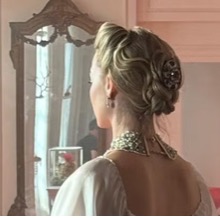
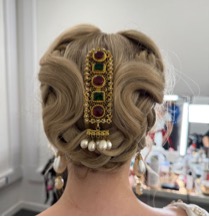
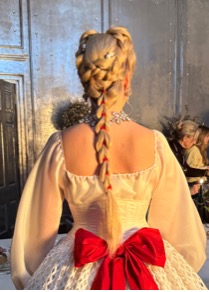
Images: Warner Bros via Harpers Bazaar
This hairstyling, I am convinced, is where all the sexual tension is displaced. In what is already becoming an iconic look from the film, Catherine’s hair is fashioned into a “corset braid”: two Dutch braids starting near her temples, then laced together down the back through narrowing criss-crosses of ribbon. (Tutorials to replicate this style are already a-dime-a-dozen on TikTok and YouTube.) Appearing so closely following the scene in which Catherine repeatedly insists that Nelly lace her “tighter! Tighter!” into the corset she wears to her wedding, it’s hard not to see the parallel between the two styles. Directly prior to her wedding night, we see the criss-crossing laces across her back; directly after, we see analogous lacing pulling together her plaits. The tension lies not only in the laces themselves, but in the sexual release that Catherine very clearly isn’t achieving with new husband. (We don’t actually see the wedding night sex, it’s true. But Catherine’s dissatisfaction with her new partner comes across quite clearly in a later scene, when she obviously fantasizes about Heathcliff during very boring missionary sex with Edgar.) In this new life, Catherine will trade the frank expression of her adolescence for an existence that’s physically more restrained, but visually far more opulent.
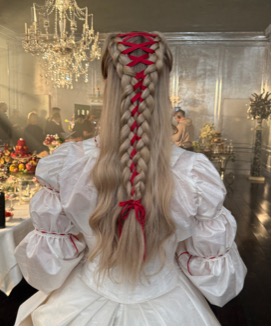
Images: Warner Bros via TheGloss
This first visual echo (between corsetted braids and corsetted back) is suggestive, but for a parallel that is positively unmissable, we can look to Catherine’s hairstyle and its mirror-image in the tiny doll Isabella fashions for her as a wedding gift. Catherine is clearly taken back by the creepy miniature. Noticing its red-laced braids identical to her own, she asks, “Is that my real hair?” And Isabella, delighted with her work, proudly affirms that it is. She clandestinely collected it from Catherine’s old hairbrush, she explains, because nothing else would do for the doll: Catherine’s hair is just “so singular.”
Here, we begin to understand that for Catherine, all the plaiting and pinning involved in her new hairstyles is a mark of erotic suppression. She is not, after all, particularly attracted to her new husband for anything other than his wealth. But for Isabella, it’s something quite different. Isabella’s obsession with ribbons is introduced as a bit of a joke—a way to make the character seem infantile and superficial. And in her enthusiasm for ordering new dresses for Catherine and styling her hair, we do sense that Isabella largely sees Catherine as a new way to play with the dolls and dollhouses that have preoccupied her oddly extended childhood. (Several critics have astutely linked this doll-like styling to Robbie’s recent role as Barbie.)
But Isabella’s play isn’t entirely childish; it shades into erotic obsession—the hair-braiding and outfit-planning a sly manifestation of the kind of bondage and control that so excites her later in the film. The obsessive impulse begins to come through as copies of Catherine proliferate: not just in doll form, but also as a snowman likeness and in a painted portrait. Her attraction, in turn, becomes clear in the second gift Isabella bestows upon Catherine: a scrapbook album of their “friendship,” featuring an extremely vaginal rose and an extraordinarily phallic pop-up mushroom. Isabella’s later infatuation with Heathcliff also seems at least partially motivated by the express desire to rouse Catherine’s jealousy.
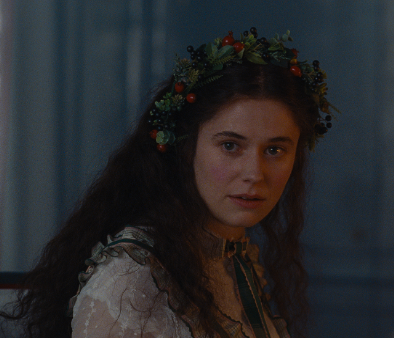
Image: Warner Bros via Variety

Catherine, for her part, is a bit too self-interested to notice the finer contours of Isabella’s (or anyone else’s) desires. Isabella may fastidiously comb and plait Catherine’s hair, but it never occurs to Catherine to return the favor. Isabella’s own hair, we notice, is invariably long and loose, her wild curls effectively untamed (barring the occasional headband or wreath). She may have a plethora of ribbons, but–fittingly, given her collaring fetish–she seems to wear them primarily around her neck, not in her hair.
But while Catherine may not be paying close attention to…well, anything, except herself…, she does intuit the importance of hair as a medium of control. In one scene, she humiliates Isabella by taunting her about her crush on Heathcliff (in front of him, no less!). Adding insult to injury, she simultaneously grabs Isabella by the hair, roughly maneuvering her across the room. Hair can be about care, yes, but it’s also very much about constraint, coercion, and control. Isabella’s anger at this treatment is intense enough that even Catherine understands the insinuated threat when she finds her doll miniature “murdered” in retaliation.
I concede, it’s not the kind of revenge we’d expect from Brontë’s original: there’s no decades-long vengeful stewing, no sins of the fathers visited on the generations to come, no mournful ghosts wandering the moors. But there are, at least, creepy dolls. And, bestowed with real hair from their unsuspecting donors, they act as unsettling extensions of their human originals. Unlike the novel, the film doesn’t allow for a second generation of the Heathcliff/Earnshaw/Linton families—but perhaps the family of dolls carries some of that symbolism? And by continuing to hang around after they have been performatively murdered, as partially embodied replicas, perhaps they carry some of the weight of ghosts.
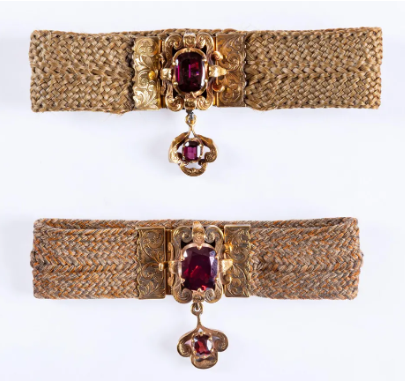
Photo: Stephen Garnett Photography for the BBC
I’m not saying it’s a perfectly satisfying parallel, but hair, here, does seem to be punching far above its weight. And while, in many ways, Fennell’s film has little to do with Brontë’s novel, or with the nineteenth-century England in which it is ostensibly set, the ubiquitous, almost over-determined symbolism of hair is the one thing that holds the film strangely close to its Victorian inspiration. I don’t mean this in a strictly literal sense—I can’t imagine anyone was wearing “victory curls” in 1840s Yorkshire—but in the sense that intense emotion and social relation is expressed primarily, and perhaps most effectively, through the idiom of hair.
In Brontë’s novel, Catherine is buried with snippets of both Edgar’s and Heathcliff’s hair tucked away inside her locket (a locket which Margot Robbie subtly evokes in the oversized heart necklace she wore for one of the film’s premieres). But more commonly, it was not the dead adorned with the locks of the living, but rather the living who touted the tresses of the dead. Emily Brontë herself had a bracelet woven of her two sisters’ hair—a replica of which Margot Robbie wore to one of the film’s premieres.

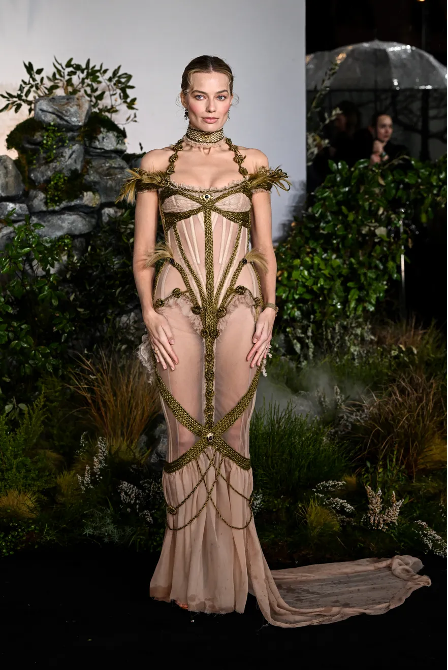
Jeff Spicer, Getty Images For Warner Bros. via USAToday
This bracelet complemented a barely-there gown with such self-effacing fabric that the garment seemed to be made almost entirely of its distinctive gold trim. A closer look reveals this trim is made entirely of real human hair, selected to match the colors in Brontë’s bracelet, then expertly plaited, feathered, and knotted in the style of Victorian mourning jewelry. The fact that the color of this hair almost exactly matches Robbie’s own adds a nice frisson of creepiness. Like the doll in the film, whose real hair transgresses the boundaries between living and non-living, person and plaything, Robbie’s ingeniously styled premiere look weaves her into the material archive of the author whose work she embodies.

Jacob Elordi, alas, has no such showstopper hair pieces for the red carpet, despite Heathcliff’s dramatic tonsorial transformation between “Jesus Elordi” (long, unkempt, scruffy) and “Jacob Darcy” (combed, cropped), as the crew allegedly referred to the character’s two distinctive hairstyles. If Catherine’s sexy energy is all bound in her updos, Heathcliff’s is largely just…shorn.
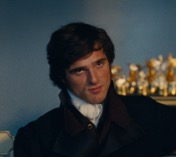
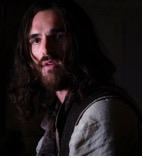
But Heathcliff’s hair does, in a way, have its one small moment of unfettered desire—not exactly in a scene from the film, but in the title card for it. Interposed between the rowdy hanging and its aftermath, a white background slowly shades into the Yorkshire valley where the film unfurls. At the same time, the film’s title scrawls itself in stop-motion animation across the expanse, spelled out in curlicues of hair clearly intended as Catherine’s and Heathcliff’s own locks. (Allegedly, some of the strands are indeed Robbie’s and Elordi’s own). When it comes to the material that writes itself into the marrow of the text, it is neither the rope of the hangman’s noose, nor the heather on the moors, but rather the lovers’ hair that has taken root.
Sophia Richardson completed her Ph.D. on Shiny Things in Shakespeare (Yale, Department of English) before becoming a lecturer on Shiny Sentences in Science (MIT, Writing & Communication Center). She sheds an unseemly amount of hair in the shower and is extremely good at French braids.
Lead Image: The film’s title card with Catherine and Heathcliff’s locks intertwined. Warner Bros.
Heathcliff images from Variety
Discover more from Avidly
Subscribe to get the latest posts sent to your email.